Luma beauty guide
Best Eyelash Growth Serum? How to Choose a Lash Serum


What is the best eyelash growth serum? It depends on what you want. The only ingredient FDA-approved to grow eyelashes is bimatoprost 0.03%, a prescription drug sold as Latisse. Without a prescription, the best lash serum is one with a full ingredient list, no hidden drug ingredients and a formula your eyes tolerate. Conditioning serums change how lashes look, not how they grow.
A "No. 1" badge on a lash serum is marketing, not a medical ranking. So instead of another brand list, here's how to choose: the three kinds of serum, what to look for on the label, how long to give one, and when to talk to a doctor first.
What kinds of lash serums are there?
Lash serums fall into three groups: prescription bimatoprost, cosmetic serums that contain a prostaglandin analog, and conditioning serums without one. Here's how they compare.
| Type (label names) | What to know |
|---|---|
| Prescription (bimatoprost ophthalmic solution 0.03%, sold as Latisse) | FDA-approved in 2008 to treat hypotrichosis, meaning not enough lashes. Needs a prescription. |
| Cosmetic with a prostaglandin analog (isopropyl cloprostenate and similar names, most with "prost" in them) | Not FDA-approved for lash growth. Their safety and effects aren't known. |
| Conditioning, no prostaglandin analog (peptides, panthenol, glycerin, plant extracts) | Made to condition lashes so they look fuller and feel softer. No formal studies on lash growth. |
Do eyelash growth serums actually work?
Prescription bimatoprost does, and the evidence is strong. In a 278-person trial published in the Journal of the American Academy of Dermatology, 78.1% of people using bimatoprost 0.03% had at least a one-grade improvement in overall lash prominence at week 16, compared with 18.4% using the same solution without the drug (Smith et al., 2012).
Cosmetic serums are a different story. The 2024 review graded peptides, panthenol and similar ingredients at the lowest level of evidence for lash growth, because no formal eyelash studies exist (Baiyasi et al.). What they do is cosmetic: lashes that look conditioned, smoother and fuller.
There's a legal reason for that line, too. Under U.S. law, a product's intended use decides whether it's a cosmetic or a drug, and the FDA names claims to "restore hair growth" as an example of a drug claim. So a cosmetic serum that promises real growth is promising more than a cosmetic is allowed to.
How do you choose a lash serum?
Start with your goal, then let the ingredient list do the rest. Here's the short checklist:
- Decide what you're after. If your lashes are sparse and you want actual growth, ask a doctor about prescription bimatoprost. If you want lashes that look fuller and feel softer, a conditioning serum fits.
- Read the full ingredient list. Cosmetics sold to consumers in the U.S. must carry an ingredient declaration, and one without it is misbranded (FDA). If a seller won't show you the list, skip it.
- Check for a prostaglandin analog. On a label, these show up as names like isopropyl cloprostenate, dechloro dihydroxy difluoro ethylcloprostenolamide, methylamido dihydro noralfaprostal or norbimatoprost (Baiyasi et al.). The AAO notes that isopropyl cloprostenate, one often found in over-the-counter serums, isn't FDA-approved and hasn't been tested by the FDA.
- Buy from a seller you trust. Labels aren't always complete. In a 2022 lab study of 64 lash serums bought from 34 websites, 4 contained bimatoprost, and only one of those said so on the package. Eight more contained prostaglandin-type compounds never used in medicines (Baiyasi et al.).
- Think about your eyes first. If you have glaucoma, eye inflammation or another eye condition, ask your ophthalmologist before using a lash growth drug like Latisse (AAO).
- Check the brush and the directions. A fine brush lets you paint a thin line at the base of the upper lashes. More isn't better: the Latisse label says extra applications won't increase lash growth (DailyMed).
How long does a lash serum take to work?
Give any lash serum at least a couple of months before you judge it. The Latisse label says the effect is gradual and isn't significant for most people until 2 months, and that lashes return to their previous look over several weeks to months after you stop (DailyMed).
That pace makes sense once you know how lashes cycle. The growth phase of an eyelash lasts about 4 to 10 weeks, and a full cycle takes about 4 to 11 months (Baiyasi et al.). A conditioning serum works on the lashes you have, so use it the way its directions say and expect a gradual change in how they look.
Which lash serum is best for sensitive eyes?
No serum is guaranteed to suit sensitive eyes, but a short ingredient list with no prostaglandin analog and no fragrance is the gentler place to start. The skin around the eyes is thin, which makes it easier for contact dermatitis to develop there, and fragrance is one of the ingredients it can react to (AAD).
A few habits help with any eye product:
- Test first. Try a small amount on your inner wrist or behind your ear and wait 24 hours, as in our guide to trying new skin care products.
- Stop if it stings. If an eye product causes irritation, stop using it, and see a doctor if the irritation doesn't go away (FDA).
- Skip it during an eye infection, and don't share eye products with anyone (FDA).
Where does Luma Lash fit?
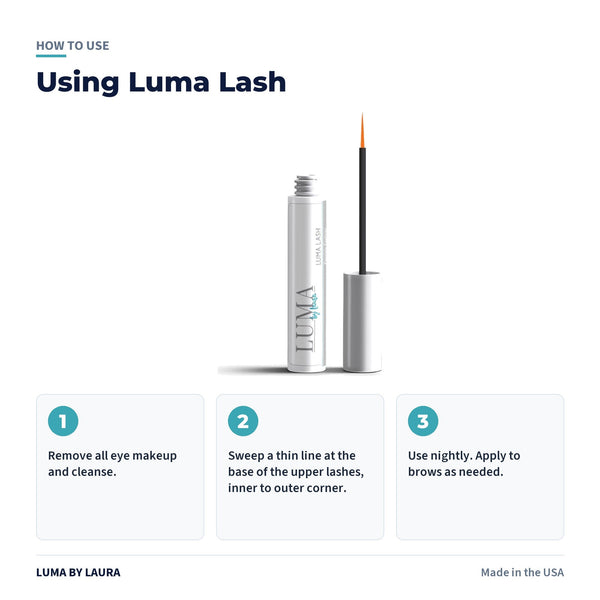
Luma Lash eyelash and brow serum is a conditioning serum, the third type in the table. Per the label, its ingredients are: Purified Water (Aqua), Myristoyl Pentapeptide-17, Cellulose Gum, Glycerin, Sodium PCA, Panthenol, Calcium Pantothenate, Vitis Vinifera (Grape) Fruit Cell Extract, Phenoxyethanol and Ethylhexylglycerin.
So it's prostaglandin-free per the published ingredient label, and no fragrance is listed. Here's what the main ingredients are there for:
- Myristoyl pentapeptide-17, a peptide used to condition lashes.
- Glycerin, a humectant that helps hold moisture in.
- Panthenol (pro-vitamin B5), a conditioning ingredient.
- Grape cell extract, a plant-derived conditioning ingredient.
You brush a thin line along the base of the upper lashes at night, or in the morning before makeup, and it works on brows too. It's made in the USA and cruelty free (see why we care about cruelty-free skin care). It's made to help lashes look longer and fuller, not to change how they grow, and results vary.
FAQ
What is the No. 1 lash serum?
"No. 1" and bestseller claims are marketing, not a medical ranking. Bimatoprost 0.03% (Latisse) is the only ingredient FDA-approved to grow eyelashes. Among cosmetic serums, pick one with a full ingredient list that suits your eyes.
Is there something better than Latisse?
For growing lashes, bimatoprost 0.03% has the strongest evidence. Other prostaglandin analogs found in cosmetic serums haven't been adequately assessed for safety. A conditioning serum is a different product with a different job: it conditions lashes so they look fuller.
Do any lash serums actually work?
Prescription bimatoprost does: 78.1% of users in a 278-person trial had more prominent lashes at 16 weeks, compared with 18.4% on the same solution without the drug. Cosmetic serums condition lashes, but no formal studies show they make lashes grow.
Does lash serum work on eyebrows?
Some lash serums are made for both. Luma Lash's directions include brows. Latisse is applied to the upper lash line only, so check the directions on whatever you buy.
Do you need a prescription for an eyelash growth serum?
You need one for Latisse. Cosmetic lash serums are sold without a prescription, but under U.S. law a product sold to make lashes grow counts as a drug.
What happens when you stop using lash serum?
The Latisse label says lashes return to their previous appearance over several weeks to months after you stop. A conditioning serum works on the look and feel of the lashes you have, so keep using it if you like the result.
Luma by Laura makes and sells Luma Lash, the serum mentioned in this article.
Sources: American Academy of Ophthalmology, "What You Should Know About Eyelash Growth Serums"; Baiyasi M et al. "Eyelash serums: A comprehensive review." Journal of Cosmetic Dermatology 2024;23:2328-2344; Smith S et al. "Eyelash growth in subjects treated with bimatoprost: a multicenter, randomized, double-masked, vehicle-controlled, parallel-group study." J Am Acad Dermatol 2012;66:801-806; U.S. FDA, "Is It a Cosmetic, a Drug, or Both? (Or Is It Soap?)"; U.S. FDA, "Eye Cosmetic Safety"; LATISSE 0.03% label, DailyMed; American Academy of Dermatology, "Itchy rash could be contact dermatitis".
This article is for general information about skin care and cosmetics. It is not medical advice. If you have a skin condition or concerns about a product or ingredient, talk to a doctor or dermatologist.
Michael GonzalesWrites about skin care and beauty for Luma by Laura. About Michael