Luma beauty guide
Prostaglandin-Free Lash Serum: What the Label Actually Tells You


What does prostaglandin-free mean on a lash serum? It means the formula contains no prostaglandin analog, the drug-like ingredient family behind prescription Latisse (bimatoprost). Prostaglandin analogs are the reason some serums carry warnings about red eyes, darker eyelids and iris color change. A prostaglandin-free serum is a conditioning cosmetic instead, so you judge it on its ingredient list, not on drug-style promises.
That label matters more in 2026 than it did a few years ago. Below: what prostaglandin analogs are, the exact names to look for on a box, what Europe's safety scientists concluded this year, and how to read any serum's ingredients in about a minute.
What is a prostaglandin analog?
A prostaglandin analog is a lab-made compound that acts like a natural prostaglandin in the body. Bimatoprost is the best-known one. It's the active ingredient in Latisse, a prescription eye solution, and the American Academy of Ophthalmology lists itchy eyes, eye redness, darker eyelid skin and a brown darkening of the colored part of the eye among its possible side effects. The Latisse prescribing information says that iris darkening is likely permanent.
Some cosmetic serums have used close cousins of bimatoprost. Those ingredients sit in a gray zone: sold as cosmetics, but with drug-like activity.
Which ingredient names mean a serum has a prostaglandin analog?
Scan the ingredient list for anything with "prost" in the name. These are the ones you're most likely to see:
| Name on the label | What it is |
|---|---|
| Bimatoprost | The prescription drug in Latisse |
| Isopropyl Cloprostenate | A prostaglandin analog used in some cosmetic lash serums |
| Dechloro Dihydroxy Difluoro Ethylcloprostenolamide (also called Ethyl Tafluprostamide) | A prostaglandin analog used in some cosmetic lash serums |
| Methylamido Dihydro Noralfaprostal | A prostaglandin analog described in the EU committee's 2026 opinion as structurally very similar to bimatoprost |
If a box only says "prostaglandin-free" on the front, check the back anyway. The ingredient list is the part a brand has to get right.
What did EU safety experts conclude about prostaglandin analogs in 2026?
In its final opinion adopted on February 2, 2026 (SCCS/1680/25), the European Commission's Scientific Committee on Consumer Safety said that none of three prostaglandin analogs, isopropyl cloprostenate, methylamido dihydro noralfaprostal and ethyl tafluprostamide, can be considered safe in cosmetic lash and brow products meant to make lashes longer. The committee pointed to the compounds' potent drug-like activity even at low concentrations, and to missing data on possible reproductive and developmental effects. It noted that most users of these products are likely to be women of child-bearing age.
That's a scientific opinion, not a U.S. rule. But it's the clearest independent statement so far on why the "prostaglandin-free" line on a label is worth looking for.
What does a prostaglandin-free serum do instead?
A prostaglandin-free serum is a leave-on conditioner for lashes and brows. Instead of a drug-like active, it relies on ingredients such as glycerin and panthenol for moisture, and peptides that coat and smooth the lash. The goal is lashes that look longer, fuller and better groomed, the way a good conditioner changes how hair looks and feels.
Set expectations to match. An American Academy of Ophthalmology ophthalmologist answering a reader's question said over-the-counter serums without prostaglandins are likely safe for your eyes, but because they're cosmetics, there are no scientific studies validating their effectiveness or safety. Results vary from person to person, and consistency matters more than any single ingredient.
Is Luma Lash prostaglandin-free?
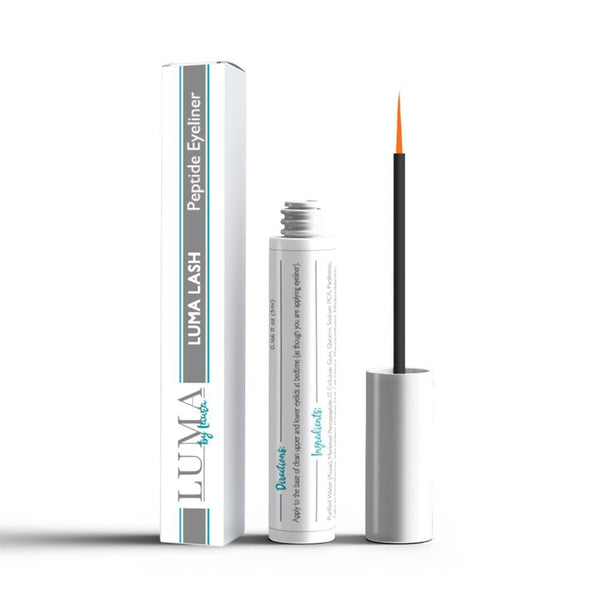
Yes. Luma Lash is prostaglandin-free, according to Luma by Laura and the ingredient label published on the Luma Lash product page. The label lists:
- Purified Water (Aqua)
- Myristoyl Pentapeptide-17
- Cellulose Gum
- Glycerin
- Sodium PCA
- Panthenol
- Calcium Pantothenate
- Vitis Vinifera (Grape) Fruit Cell Extract
- Phenoxyethanol
- Ethylhexylglycerin
None of those is a prostaglandin analog, and nothing on the list has "prost" in its name. Myristoyl pentapeptide-17 is a peptide, glycerin and sodium PCA help hold moisture, and panthenol (pro-vitamin B5) is a conditioning ingredient. Luma Lash is a cosmetic, not a drug, so its page describes lashes that look longer and fuller, not a change to the lash itself.
How do you read any lash serum label in a minute?
- Find the full ingredient list. On a product page it's often a photo of the box. If you can't find it, ask the brand before you buy.
- Search for "prost." Any ingredient containing it is a prostaglandin analog or the prescription drug itself.
- Check the claims. Cosmetic serums should talk about how lashes look. Words that promise to change the lash itself belong on a drug label.
- Read the cautions. Every serum, prostaglandin-free or not, should tell you to avoid direct contact with the eyes and to stop if irritation happens.
- Patch-test and go slow. Start with a thin line at the lash base, as shown in our guide to how to apply lash serum.
The U.S. Food and Drug Administration also advises never sharing or swapping eye cosmetics, even with a close friend, because another person's germs can be hazardous to you.
FAQ
Are prostaglandin-free lash serums safe?
Serums without a prostaglandin analog are likely safe for your eyes, according to an American Academy of Ophthalmology ophthalmologist, though as cosmetics they haven't been studied the way a drug is. Any eye product can still cause irritation or an allergic reaction, so stop using it if your eyes react.
Do prostaglandin-free serums change eye color?
Iris darkening is a known effect of prostaglandin-type products such as Latisse, and its label calls it likely permanent. A serum with no prostaglandin analog doesn't carry that ingredient, so that specific warning doesn't apply to it.
How can I tell if my lash serum has prostaglandins?
Read the full ingredient list and look for bimatoprost, isopropyl cloprostenate, ethyl tafluprostamide (dechloro dihydroxy difluoro ethylcloprostenolamide) or methylamido dihydro noralfaprostal. Anything with "prost" in the name is the giveaway.
Is Latisse prostaglandin-free?
No. Latisse is bimatoprost ophthalmic solution 0.03%, a prostaglandin analog sold by prescription in the U.S.
Can I use a prostaglandin-free serum on my brows?
Many conditioning serums are made for both. Luma Lash's directions cover brows: apply a small amount to the base of the brows and sweep upward.
What's the difference between lash serums and brow serums?
Often not much: many formulas are labeled for both. Our guide to eyelash and brow serums explains what's inside them and how to use one. For the full rundown of reported reactions, see eyelash serum side effects.
More Luma lash guides: lash serum vs. extensions vs. falsies and how to choose a lash serum.
Luma by Laura makes and sells Luma Lash, the lash serum mentioned in this article.
Sources: European Commission, Scientific Committee on Consumer Safety, "Opinion on prostaglandin analogues: MDN, IPCP, DDDE"; American Academy of Ophthalmology, "Latisse"; American Academy of Ophthalmology, Ask an Ophthalmologist, "Are eyelash growth serums safe?"; DailyMed, LATISSE 0.03% prescribing information; U.S. FDA, "Eye Cosmetic Safety".
This article is for general information about skin care and cosmetics. It is not medical advice. If you have a skin condition or concerns about a product or ingredient, talk to a doctor or dermatologist.
Michael GonzalesWrites about skin care and beauty for Luma by Laura. About Michael