Luma beauty guide
Eyelash and Brow Serums: What's in Them and How to Use One


What is an eyelash and eyebrow serum? It's a leave-on product you brush along the base of your upper lashes or onto your brows, usually once a day. Most cosmetic serums use conditioning ingredients such as peptides, panthenol and glycerin so hairs look fuller and feel softer. Some contain a prostaglandin analog, a drug-like ingredient, so check the label.
This guide covers what those ingredients are there for, how to read a serum's ingredient list, how lashes and brows differ, and the basics of using one. If you're still deciding which kind of lash serum to buy, start with our guide to choosing a lash serum.
What's in an eyelash and eyebrow serum?
Lash and brow serums fall into two families: those with a prostaglandin analog and those without one (Baiyasi et al., 2024). Here are the ingredient types you'll see most often and what each one is there for.
| Ingredient type (label names) | What it's there for |
|---|---|
| Peptides (myristoyl pentapeptide-17, myristoyl hexapeptide-16, acetyl tetrapeptide-3) | Conditioning. Published peptide studies so far are on scalp hair, not lashes. |
| Panthenol (pro-vitamin B5) | Added because it's believed to reduce breakage. |
| Glycerin | A humectant, meaning it helps hold moisture in. |
| Plant extracts and oils (ginseng, pumpkin seed oil, castor oil) | Conditioning. Castor oil is popular in vegan lash serums, but studies on lashes are lacking. |
| Preservatives (phenoxyethanol) | Keep bacteria, fungi and yeast out of a water-based formula. |
| Prostaglandin analogs (isopropyl cloprostenate and other names with "prost") | Drug-like ingredients. Bimatoprost is the only one FDA-approved for lashes, and only by prescription. |
Table sources: Baiyasi et al., 2024, the American Academy of Ophthalmology, and the Personal Care Products Council's CosmeticsInfo pages on glycerin and phenoxyethanol.
Two things to know about that table. First, the conditioning ingredients are there for how lashes and brows look and feel. The 2024 review gave peptides, panthenol, ginseng and pumpkin seed oil its lowest evidence grade for lashes, because adequate eyelash studies don't exist yet (Baiyasi et al.).
Second, the prostaglandin analogs are a different kind of ingredient. The AAO says isopropyl cloprostenate, which shows up in some over-the-counter serums, isn't FDA-approved and hasn't been tested by the FDA. It also lists possible effects of the prescription drug, including red eyes, darker eyelid skin and iris darkening that can be irreversible (AAO).
How do you read a lash serum ingredient label?
Read it from the top down. In the U.S., cosmetics sold to consumers must list their ingredients, and a product without that list is misbranded (FDA). A few rules make the list easier to decode:
- The first ingredient is the main one. Ingredients are listed in descending order of how much is in the product (21 CFR 701.3). In a water-based serum, that's water.
- The tail end is loose. Ingredients at 1% or less can be listed in any order after the rest, so you can't rank the last few by amount (21 CFR 701.3).
- "Active ingredients" means drug. A product that's both a cosmetic and a drug lists its drug ingredients first as "Active Ingredients," followed by everything else as "Inactive Ingredients" (FDA).
- Scan for "prost." The prostaglandin analogs named in the 2024 review, from bimatoprost and latanoprost to isopropyl cloprostenate, all have those letters in their names (Baiyasi et al.).
- Read the claims, too. Under U.S. law, a product's intended use decides whether it's a cosmetic or a drug, and the FDA gives claims to "restore hair growth" as an example of a drug claim (FDA). A cosmetic serum should talk about how lashes look, not promise to change the hairs themselves.
Can you use lash serum on your eyebrows?
Yes, if the serum's directions include brows. If the label only mentions lashes, or it's a prescription lash product, use it only as directed.
Lashes and brows are both short hairs, but they don't behave the same way:
- Lashes have an active phase of about 4 to 10 weeks, and a full cycle takes about 4 to 11 months (Baiyasi et al.).
- Brows have an active phase of about 2 to 3 months, followed by a resting phase of about 2 to 3 months. Compare that with scalp hair, whose active phase lasts 2 to 8 years, which is why brows and lashes stay so much shorter (Nguyen et al., 2023).
- Brow skin is thin and delicate and easily damaged, and daily plucking can cause scarring (Cleveland Clinic).
Sparse brows aren't always about grooming. Thyroid conditions and anemia can thin brows (Cleveland Clinic), and losing the outer third of the brow can be a sign of an underactive thyroid (Nguyen et al.). If that sounds like you, see a doctor before reaching for a serum.
How do you use an eyelash and eyebrow serum?
Follow the directions on your product. As an example, here's how Luma Lash's directions put it.

For lashes:
- Remove all eye makeup and cleanse.
- Brush a thin line along the base of the upper lashes, from the inner corner outward, as close to the lash line as you can.
- Use it nightly before bed, or in the morning before makeup. Let it dry before you apply anything else.
For brows: start at the base of the brow and use a vertical sweep, as needed.
A few habits apply to any eye-area product. Wash your hands first, don't share it, and skip it if you have an eye infection or the skin around your eyes is inflamed (FDA). Keep the serum out of the eye itself, and stop using it if it irritates.
How long before you see a difference?
Plan on a couple of months. Because lashes and brows cycle slowly, any change in how they look will be gradual. For overplucked brows, the Cleveland Clinic says to be patient for a few months and to see a dermatologist if nothing has changed after about four months (Cleveland Clinic).
A conditioning serum works on the lashes and brows you already have, so think of it as part of a routine, like a conditioner for your hair. Results vary from person to person.
Who should check with a doctor first?
Check with a doctor before you try a serum if:
- You have an eye condition, such as glaucoma or eye inflammation. The AAO advises asking your ophthalmologist before using a lash drug like Latisse (AAO).
- Your lashes or brows thinned suddenly or in patches, which can have medical causes (Nguyen et al.).
- A product irritated your eyes and the irritation doesn't go away after you stop (FDA).
If your skin is sensitive, a patch test helps. Our guide to trying new skin care products walks through it.
Where does Luma Lash fit?
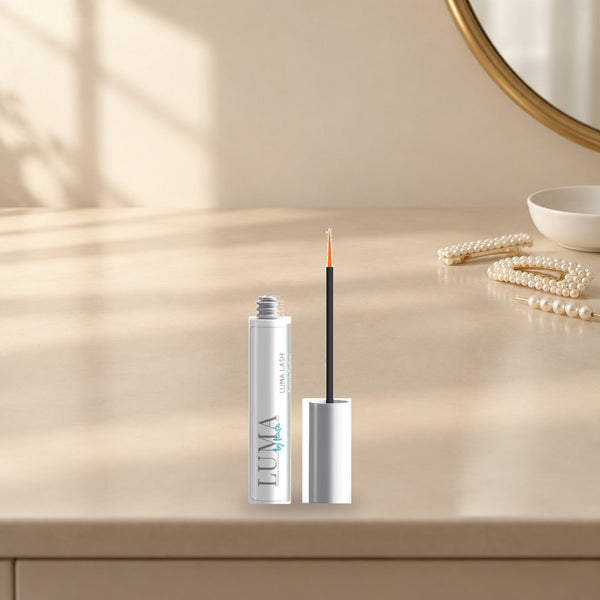
Luma Lash eyelash and brow serum is in the no-prostaglandin family. Per its label, the ingredients are: Purified Water (Aqua), Myristoyl Pentapeptide-17, Cellulose Gum, Glycerin, Sodium PCA, Panthenol, Calcium Pantothenate, Vitis Vinifera (Grape) Fruit Cell Extract, Phenoxyethanol and Ethylhexylglycerin.

Read with the rules above: water comes first, the peptide and glycerin do the conditioning, and phenoxyethanol is the preservative. There's no "prost" name and no fragrance listed. It's prostaglandin-free, per Luma by Laura and the published ingredient label.
The directions cover both lashes and brows. It comes in a 5 ml tube with a fine brush, and it's made in the USA and cruelty free (here's why we care about cruelty-free skin care). It's made to help lashes and brows look longer and fuller, and results vary.
FAQ
Can I use brow serum as a lash serum?
Only if its directions include the lash line. The FDA advises using only products intended for the eye area near your eyes. A serum labeled "lash and brow" is made for both.
What is the best serum for eyebrows?
There's no single best one. Look for a serum whose directions include brows, with a full ingredient list and no ingredients you've reacted to before. Then give it a few months, since brows cycle slowly.
How can I make my lashes look fuller?
For today, mascara and a lash curler change how lashes look right away. A conditioning serum works more slowly: use it nightly for a couple of months, and expect a gradual change in how your lashes look and feel.
How long does a lash and brow serum take to work?
Give it at least a couple of months. A lash's active phase lasts about 4 to 10 weeks and a brow's about 2 to 3 months, so any change shows up gradually.
Is castor oil good for eyelashes?
Castor oil is a popular ingredient in vegan lash serums, but a 2024 review found too few studies to say whether it does anything for lashes. If you use any oil or serum near your eyes, choose one made for the eye area.
Should you put lash serum on your lower lashes?
Follow your product's directions. Luma Lash's directions say to apply it along the base of the upper lashes only.
Luma by Laura makes and sells Luma Lash, the serum mentioned in this article.
This article is for general information about skin care and cosmetics. It is not medical advice. If you have a skin condition or concerns about a product or ingredient, talk to a doctor or dermatologist.
Michael GonzalesWrites about skin care and beauty for Luma by Laura. About Michael