Luma beauty guide
How to Use Hyaluronic Acid in Your Skin Care Routine


How do you use hyaluronic acid? Wash your face, leave your skin a little damp, and smooth on a few drops of hyaluronic acid serum. Then follow right away with a moisturizer to seal the water in. Use it morning and evening, before thicker creams, and finish with sunscreen in the daytime.
Below: what hyaluronic acid does, the step-by-step routine, where it goes when you use vitamin C or retinol, how it works around your eyes and lips, and what you can realistically expect.
What does hyaluronic acid do for your skin?
Hyaluronic acid is a sugar molecule your body makes on its own. It's a humectant, which means it attracts and holds water, and it can bind over a thousand times its weight in water (Harvard Health). Cleveland Clinic puts it another way: a quarter teaspoon holds about one and a half gallons of water.
Your skin makes less of it as you get older, which is one reason skin can feel drier with age. In skin care, it helps the top layer of skin hold moisture so it feels softer and looks smoother and plumper. Harvard Health's reviewing dermatologist, Abigail Waldman, MD, compares it to a water balloon: full of water, it looks smooth and taut; empty, it looks wrinkled.
On labels you'll also see sodium hyaluronate and hydrolyzed hyaluronic acid. Dr. Waldman says these lab-made forms work the same way as the natural substance.
How do you use hyaluronic acid step by step?
Here's the routine Harvard Health, Cleveland Clinic and the American Academy of Dermatology (AAD) describe:
- Cleanse. Wash with a gentle cleanser and pat your face with a towel so it's still slightly damp.
- Apply hyaluronic acid to damp skin. A few drops of serum is plenty, or follow the amount on your product. Damp skin gives it water to hold on to.
- Add anything else in order of thickness. Go from thinnest to thickest, and keep it simple. Cleveland Clinic dermatologist Sean McGregor, DO, suggests using as few products as you can.
- Seal it with moisturizer right away. Dr. Waldman recommends a moisturizer with an occlusive ingredient, such as petrolatum, mineral oil, shea butter, cocoa butter or jojoba oil, to keep the water from evaporating.
- Finish with sunscreen in the morning. The AAD recommends a broad-spectrum sunscreen with SPF 30 or higher.
That's the whole method. The two details that matter most are damp skin and a moisturizer on top.
Do you put hyaluronic acid on before or after moisturizer?
Before. The general rule is lightest to heaviest: cleanser, serum, moisturizer, then sunscreen in the morning (Cleveland Clinic). A thin serum goes on first, and a thicker gel, lotion or cream goes on top.
If your hyaluronic acid is already in your moisturizer, you don't need a separate serum. Just apply the moisturizer to damp skin.
| Step | Morning | Evening |
|---|---|---|
| 1 | Gentle cleanser | Gentle cleanser |
| 2 | Vitamin C serum (if you use one) | Hyaluronic acid serum on damp skin |
| 3 | Hyaluronic acid serum | Retinol (if you use one) |
| 4 | Eye cream | Eye cream |
| 5 | Moisturizer | Moisturizer |
| 6 | Sunscreen, SPF 30 or higher | Not needed at night |
When should you use hyaluronic acid, morning or night?
Both are fine. Harvard Health says you can use a hyaluronic acid serum in the morning and evening, after cleansing and while your skin is still damp. If you only want to add one step, pick the time you're most likely to stick with.
Can you use hyaluronic acid with vitamin C or retinol?
Yes to both, in a set order.
- Vitamin C: apply the vitamin C serum first, then hyaluronic acid. Dr. Waldman says vitamin C, especially L-ascorbic acid, needs to go on first to work best. She adds that people who find vitamin C irritating could benefit from pairing it with hyaluronic acid, and that some serums combine the two if you'd rather use just one.
- Retinol or glycolic acid: these can cause dryness and irritation. Harvard Health says putting hyaluronic acid on first can help your skin tolerate them better.
Cleveland Clinic notes that retinoids are usually an evening product, so the retinol pairing belongs in your night routine. Starting several new products at once makes it hard to tell which one bothers your skin, and the AAD warns that using too many products can irritate skin.
Can you use hyaluronic acid under your eyes?
Yes. It's a common ingredient in eye creams. In one study, 76 women aged 30 to 60 used creams with 0.1% hyaluronic acid around their eyes twice a day for 60 days, and the researchers reported better skin hydration and elasticity with all of the hyaluronic acid creams (Pavicic et al., 2011). It was a small study of specific formulas, so read it as a sign of what the ingredient can do, not a promise for any one product.
The skin around your eyes is thin, so be gentle. The AAD suggests applying eye products with your ring finger, which naturally uses less pressure. Keep products out of your eyes.
What about hyaluronic acid on your lips?
It's in plenty of lip products too, for the same reason: it helps hold moisture. If your lips feel dry, the AAD suggests lip balm or petroleum jelly. Luma Lips, our plumping gloss, lists hyaluronic acid and vitamin E alongside capsaicin, which gives the plumping tingle. Our guide to what's in lip plumper explains each ingredient.
How long does hyaluronic acid take to work?
The moisture is immediate, and the look builds over days. "It's not going to give you the really plump skin that you had when you were 20, but after a week, you should notice a mild softening of wrinkles, a bit more fullness, and less dry skin," Dr. Waldman told Harvard Health.
Results depend partly on molecular weight. Larger molecules hold more water but stay on the surface. Smaller ones hold less but go a little deeper. Dr. Waldman suggests looking for a serum with both.
Is hyaluronic acid safe for every skin type?
Harvard Health calls it safe and unlikely to cause side effects when used on skin, and Cleveland Clinic also considers topical hyaluronic acid safe. It isn't known to cause acne. If you break out after a new product, Harvard suggests checking the other ingredients, such as cocoa butter or lanolin.
Any product can still disagree with your skin. The AAD recommends testing a new product on a small spot, like the inside of your elbow, twice a day for seven to 10 days before using it on your face. Our tips for trying new skin care products walk through it. Stop using anything that stings or turns your skin red.
Injected hyaluronic acid fillers are a different thing entirely. Cleveland Clinic says those should only be done by a trained professional.
Where does Luma Lift fit?
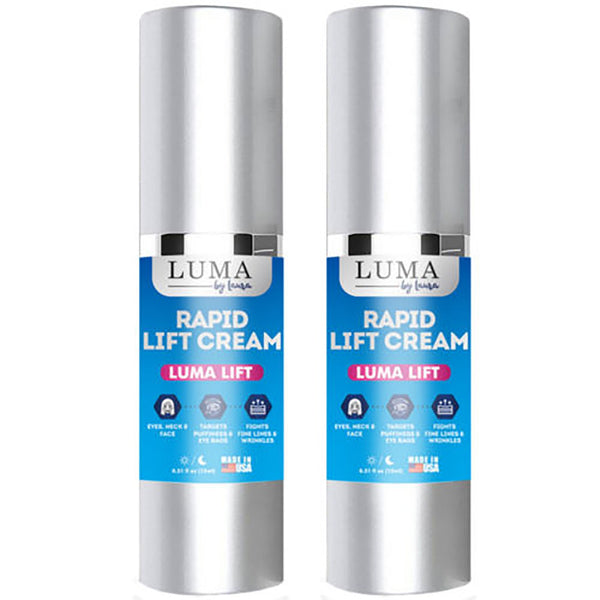
Luma Lift instant eye lift cream is our eye cream, and sodium hyaluronate is one of its listed key ingredients, along with three peptides. It helps the skin around your eyes hold moisture, so the area looks smoother and plumper. As it dries, it also gives a temporary tightening feel.
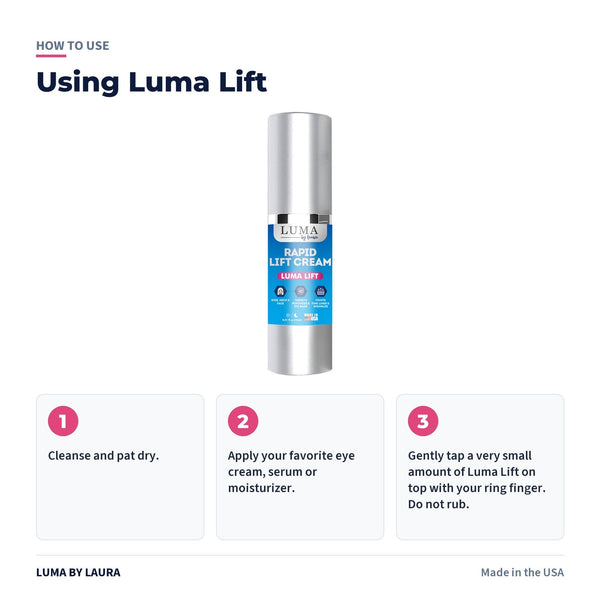
It goes near the end of your routine: after cleansing, your hyaluronic acid serum and your usual eye cream or moisturizer, tap a very small amount on with your ring finger. Our step-by-step guide shows how to apply Luma Lift. It's a cosmetic, so the effect is on how the area looks, and it's temporary. Results vary. The rest of our eye care range is here, and our guide to under-eye wrinkles covers what an eye cream can and can't do.
FAQ
How do you apply hyaluronic acid serum?
Cleanse, leave your skin slightly damp, then smooth a few drops over your face. Follow right away with a moisturizer, and add sunscreen in the morning.
Should hyaluronic acid go on wet or dry skin?
Damp skin. Harvard Health says damp skin gives hyaluronic acid the water it needs, and a moisturizer on top keeps that water from evaporating.
Do you put hyaluronic acid before or after moisturizer?
Before. Layer thinnest to thickest: serum first, then moisturizer, then sunscreen in the morning.
Can you use vitamin C and hyaluronic acid together?
Yes. Apply the vitamin C serum first, then hyaluronic acid. Some serums combine the two.
Can you use hyaluronic acid with retinol?
Yes. Harvard Health says applying hyaluronic acid first can help your skin tolerate retinol, which can be drying.
Can you use hyaluronic acid every day?
Yes. Harvard Health says you can use it morning and evening after cleansing.
How long does hyaluronic acid take to work?
Your skin feels more hydrated right away. A Harvard dermatologist says you may notice a bit more fullness and less dryness after about a week.
Luma by Laura makes and sells Luma Lift and Luma Lips, the products mentioned in this article.
Sources: Harvard Health Publishing, "Hyaluronic acid for skin: Benefits, how to use it, and side effects"; Cleveland Clinic, "Hyaluronic Acid"; Cleveland Clinic, "The Correct Order for Skin Care Products"; American Academy of Dermatology, "Should I apply my skin care products in a certain order?"; American Academy of Dermatology, "How to treat dry skin: Dermatologist tips for relief"; American Academy of Dermatology, "How to test skin care products"; Pavicic et al., "Efficacy of cream-based novel formulations of hyaluronic acid of different molecular weights in anti-wrinkle treatment." Journal of Drugs in Dermatology 2011;10:990-1000.
This article is for general information about skin care and cosmetics. It is not medical advice. If you have a skin condition or concerns about a product or ingredient, talk to a doctor or dermatologist.
Michael GonzalesWrites about skin care and beauty for Luma by Laura. About Michael